No products in the cart.
4 Best Natural Sleep Aids for Adults – Review Now

This post contains affiliate links. If you purchase through these links, Calmly Rooted earns a commission at no extra cost to you. We only recommend premium products we thoroughly vet and trust.
Research-Backed Insights | Updated October 2026 The Calm Collective Blog is a curated educational resource by CalmlyRooted.com. We explore plant-based, restorative strategies designed to help you navigate systemic wellness with clarity and intention.
After a long workday, lying awake in a quiet house can make any sleep promise sound appealing. We assess the best natural sleep aids for adults by their purpose and evidence, rather than popularity.
A calming ritual can feel welcome without being a proven insomnia treatment. Start with what’s disrupting your sleep before choosing an option.
Need to Know: Natural doesn’t mean risk-free. These four options have different evidence and cautions. Persistent sleep trouble deserves professional attention, rather than an expanding supplement collection.
Key Takeaways
- Melatonin may suit travel-related schedule changes, but timing matters and benefits don’t cover every sleep measure.
- Magnesium research remains limited and mixed; chamomile tea can support a ritual without proving an insomnia benefit.
- Valerian has inconsistent clinical findings, and long-term safety information is limited for several popular supplements.
- Persistent sleep problems deserve assessment; CBT-I has stronger support than sleep-hygiene advice alone for chronic insomnia.
- Independent testing assesses contents and contaminants, not whether a product will improve your sleep.
Best natural sleep aids for adults: four options and what they may offer
We don’t treat “natural” as proof of safety or effectiveness.
Evidence snapshot: NCCIH’s sleep approaches overview distinguishes melatonin’s potential timing benefits from the limited, inconclusive, or inconsistent insomnia evidence for magnesium, chamomile, and valerian.

Melatonin may suit a shifted body clock
Melatonin signals that nighttime is approaching. Evidence is more encouraging for jet lag and shift-work disruptions than ongoing insomnia. Possible improvements in sleep onset don’t establish benefits for sleep quality or nighttime awakenings.
Short-term use appears relatively safe for many adults; long-term safety remains unclear. People taking blood thinners or living with epilepsy need medical guidance.
Magnesium may appeal when the body feels tense
Magnesium supports normal nerve and muscle function, but feeling tense doesn’t establish a deficiency. Sleep research remains limited and mixed.
The adult upper limit is 350 mg daily from supplements and medicines, unless a clinician advises otherwise. Magnesium naturally present in food doesn’t count toward that limit. Higher supplemental amounts can cause stomach upset.
Chamomile can make a bedtime ritual feel gentler
We view chamomile tea as a familiar wind-down cue. Clinical evidence for insomnia remains inconclusive. If you’re allergic to ragweed or related plants, chamomile may trigger a reaction.
Valerian has a long history, but mixed research
Valerian has traditional use, but clinical findings are inconsistent. The AASM guideline didn’t support it for chronic insomnia. Long-term safety is uncertain, and missing interaction information doesn’t establish safety.
How to choose a sleep aid that fits your routine and your needs
We start with the concern, rather than the supplement shelf. Travel-related schedule changes, an overstimulating evening, and persistent insomnia call for different responses.
Match the option to the underlying concern
Melatonin deserves consideration when sleep timing has shifted. Meanwhile, tea or a light-blocking mask may suit someone seeking a calmer evening ritual.
Recurring difficulty sleeping needs more than sleep-hygiene tips. The AASM behavioral treatment guideline strongly recommends cognitive behavioral therapy for insomnia, or CBT-I, for adults with chronic insomnia.
CBT-I addresses sleep-related thoughts and behaviors. Its tools include stimulus control, planned time in bed, and cognitive strategies. A course commonly involves six to eight sessions.
Educational self-assessment, not a diagnosis
- Notice whether trouble follows travel or schedule changes.
- Record effects on concentration, mood, or daytime alertness.
- Report loud snoring, gasping, or witnessed breathing pauses.
Track patterns without making sleep another job

A brief sleep journal helps capture patterns without constant overnight monitoring.
A simple seven-night protocol
- Record estimated bedtime, wake time, awakenings, caffeine or alcohol timing, and next-day energy.
- Choose one manageable change, such as setting your phone aside before bed.
- Review the week’s patterns instead of judging individual nights.
Brief estimates are enough. We recommend writing notes in the morning instead of checking the clock repeatedly overnight. Changing several habits simultaneously makes it harder to understand what helped.
Our sleep routines and supplements guide offers additional routine ideas. However, ongoing daytime impairment or concerning breathing changes warrant professional advice without waiting for self-help to fail.
How to compare sleep products without getting swept up in the claims
We separate convenient formats, sensory accessories, and clinical evidence. A premium presentation doesn’t establish that a product improves sleep.
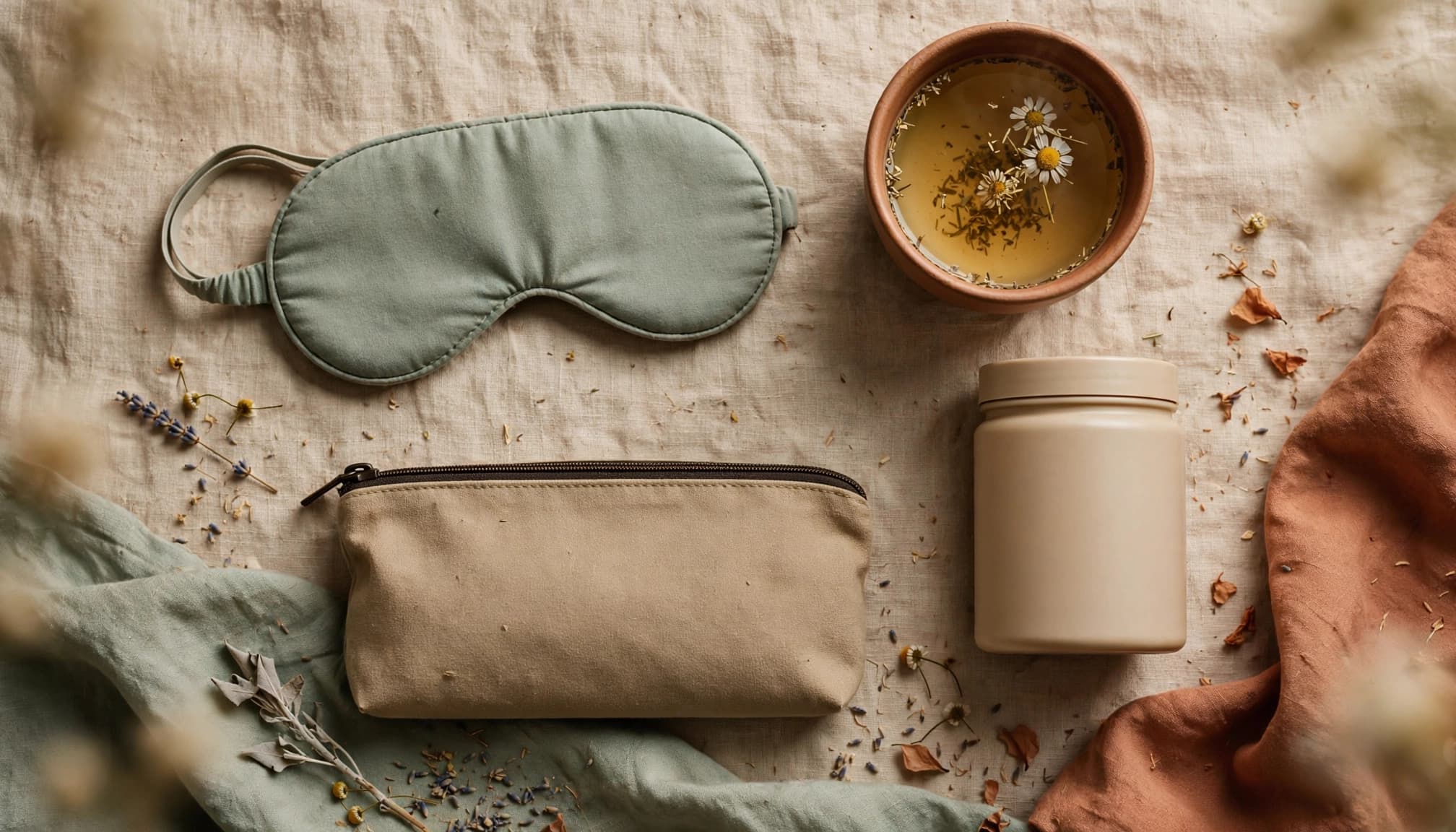
*Generic sleep accessories illustrate routine choices, rather than either featured product.
Compare the format and the practical value
The DEEPS Complete Nightly Sleep Set costs $67.95 (check current sale price). Its listing includes 12 sleep patches, a weighted lavender sleep mask, sandalwood incense with a glass holder, an essential-oil roll-on, and a reusable water-resistant Tyvek travel bag.
For someone wanting physical bedtime accessories together, DEEPS is the clearer lifestyle match. However, its components aren’t evidence of an insomnia benefit. The listing’s single customer rating is anecdotal, not proof.
If your priority is a softgel format rather than a collection of sensory accessories, the Joy Organics option is the closer format match. That distinction doesn’t establish better effectiveness or value.
We also distinguish quality documentation from outcome research. Calmly Rooted’s lab-testing information describes independent reports addressing cannabinoid concentration and contaminants.
Perfect Pairing: combine a product with a steady wind-down cue
You can explore the Joy Organics softgel format alongside review DEEPS pricing and contents.
The practical pairing combines an established routine with a light-blocking accessory.
A More Informed Path to Rest
The right option depends on what’s disrupting your sleep, and no supplement is a guaranteed fix. We favor small, trackable routine changes and professional guidance when sleep problems persist, rather than repeatedly adding products after a difficult night. A short diary can make that conversation more concrete without turning every awakening into another task. Keep the distinction between an enjoyable ritual, documented product contents, and demonstrated clinical benefit clear as you choose.
Published By: